Odoo Community vs Enterprise: Is the Free Version Enough?
Odoo Community vs Enterprise explained: editions, switching, Egypt ETA and Saudi tax updates in Odoo 19.4, and how to choose before go-live in Egypt and KSA.
Updated 28 November 2026 · Reviewed by Mastery IT engineering team · Sources at the end
Quick answer
Odoo Community is the open-source edition and Odoo Enterprise is the licensed edition built on it; Odoo says you can switch between them at any time. Whether the free version is enough depends on the modules you need, your upgrade and support plan, and local tax features for Egypt (ETA) and Saudi Arabia (ZATCA), which arrive with localisation releases such as Odoo 19.4 (July 2026). Get the edition check in writing before you sign.
Many companies in Egypt and Saudi Arabia ask the same first question when they look at Odoo: can we start with the free version and upgrade later? Mastery IT is an Odoo Learning Partner and implements Odoo for companies in both markets, so we see where the choice matters and where it does not.
What is the difference between Odoo Community and Odoo Enterprise?
Odoo Community is the open-source core of the platform. Odoo Enterprise is the licensed edition built on that core, and Odoo’s own editions page states that the two can be switched at any time. The editions page compares them by general features, functional support, version upgrades, hosting, and customisation, but the ticks per row are the part to check on the live page before you decide, because the split changes between versions.
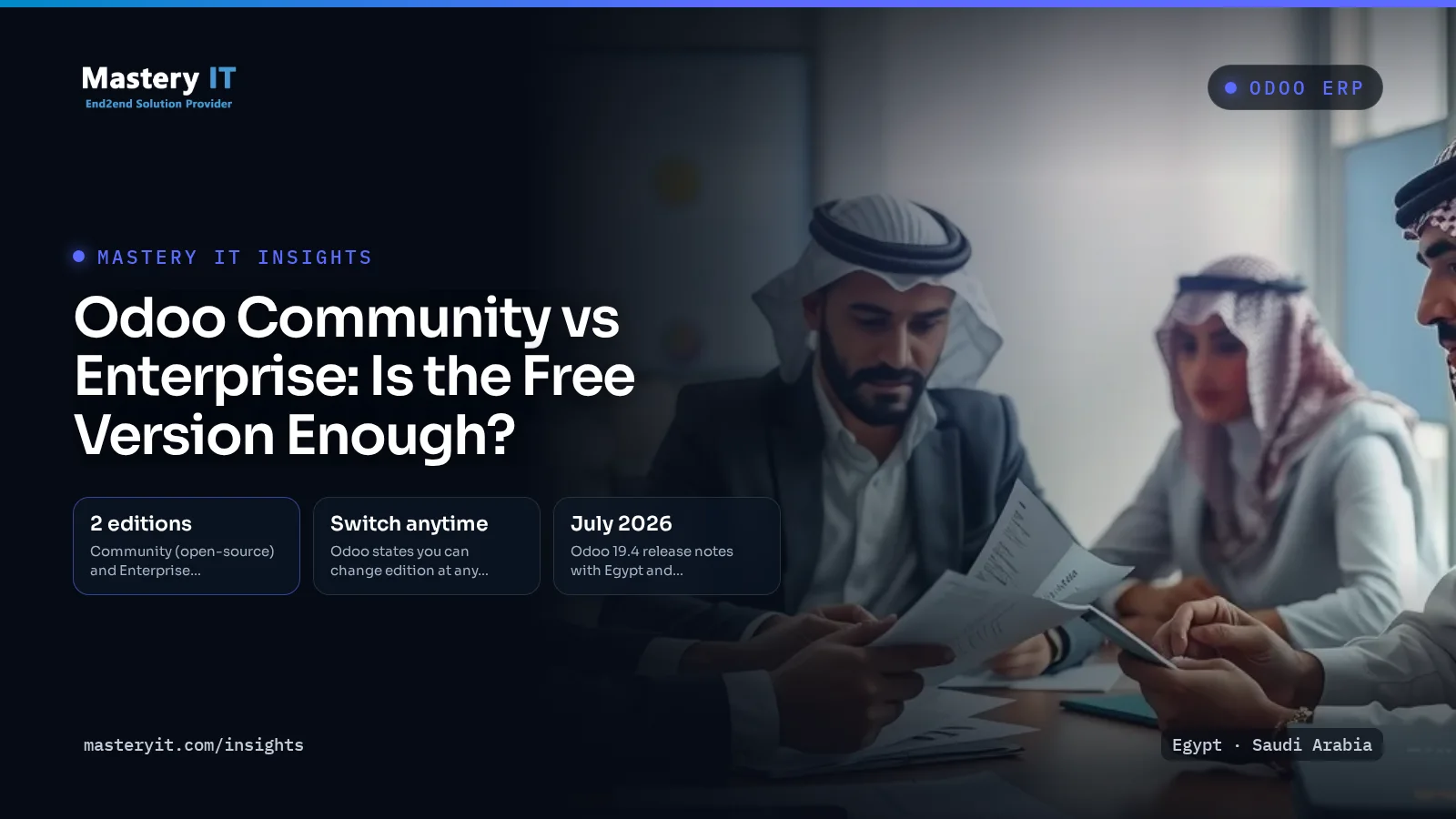
- 2 editionsCommunity (open-source) and Enterprise (licensed), per the Odoo editions page
- Switch anytimeOdoo states you can change edition at any time
- July 2026Odoo 19.4 release notes with Egypt and Saudi tax updates
- Quote on requestOdoo lists no public price; the editions page asks you to contact sales
Which local tax features do Egypt and Saudi companies need?
Local compliance is where the version you pick matters most. The Odoo 19.4 release notes (July 2026) list concrete changes for both markets. For Egypt, the VAT return and withholding reports were updated to support ETA compliance, obsolete schedule taxes were removed, and unit-of-measure codes were aligned with the latest ETA rules. For Saudi Arabia, less common taxes were removed to prevent wrong selections, the base tax grids for 0% PE and 0% PH were updated, partner records can hold a Saudi national ID, Iqama or GCC ID, and a rejected invoice can be reset to draft, corrected and sent again.

| Question to ask | Why it matters | Where to check |
|---|---|---|
| Which modules do we need in year one? | Each module changes the licence and implementation scope | Odoo editions page, module list |
| Does our version include the ETA or ZATCA changes? | Localisation changes ship with specific versions | Odoo release notes for your version |
| Who upgrades the system, and when? | Upgrades are a planned project, not a button | Your support and hosting agreement |
| Where does the database live? | Hosting affects backups, uptime and data location | Your hosting plan, written down |
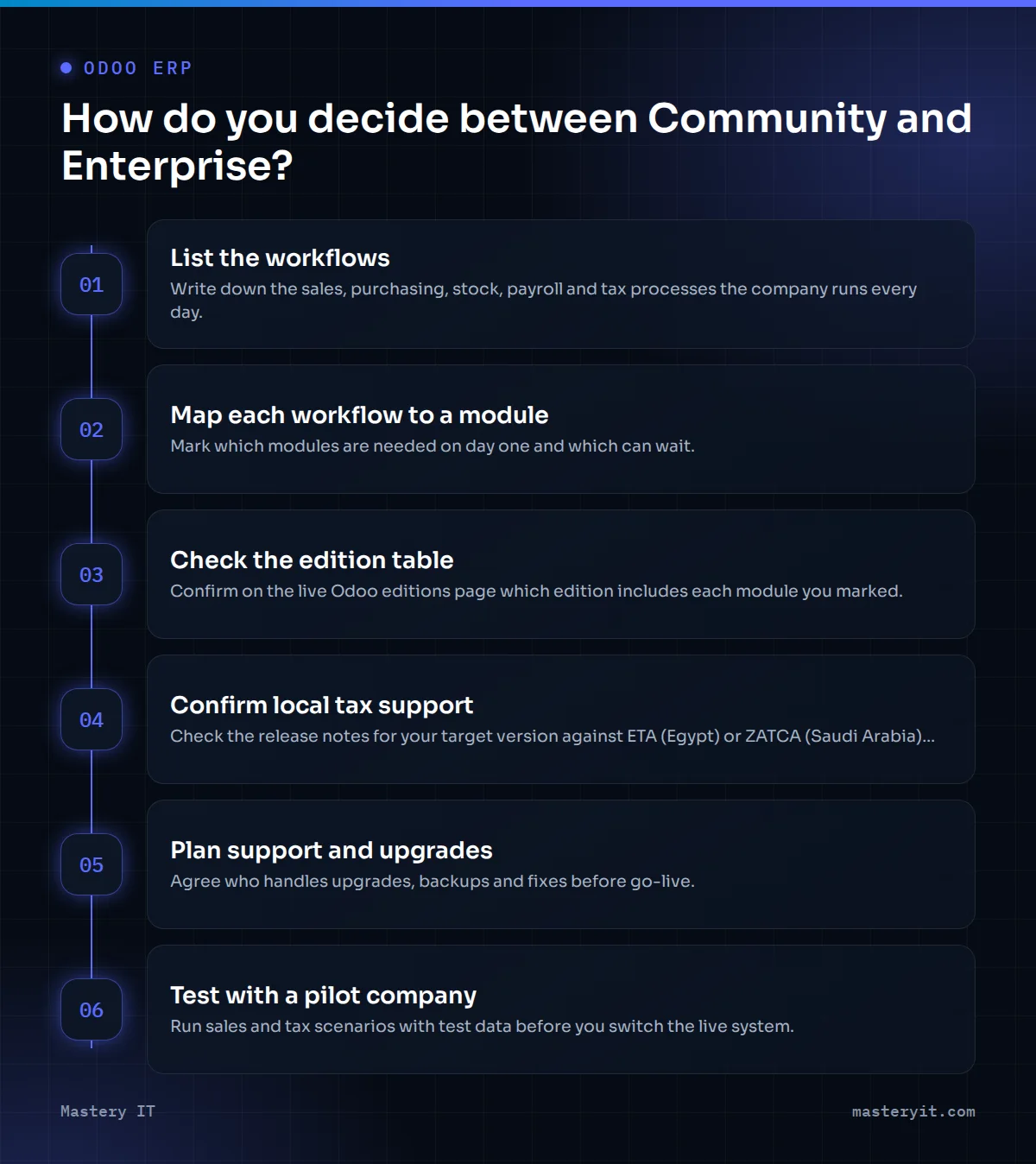
How do you decide between Community and Enterprise?
- List the workflows. Write down the sales, purchasing, stock, payroll and tax processes the company runs every day.
- Map each workflow to a module. Mark which modules are needed on day one and which can wait.
- Check the edition table. Confirm on the live Odoo editions page which edition includes each module you marked.
- Confirm local tax support. Check the release notes for your target version against ETA (Egypt) or ZATCA (Saudi Arabia) requirements.
- Plan support and upgrades. Agree who handles upgrades, backups and fixes before go-live.
- Test with a pilot company. Run sales and tax scenarios with test data before you switch the live system.
Do not decide on the licence line alone. A free edition with a missing local tax report costs more in manual work than a licensed edition that covers the process end to end.
What does a typical Odoo project include beyond the edition?
The edition is one line in the budget. Process mapping, data migration from the old system, tax configuration, user training, integrations with payment or e-invoicing tools, hosting setup and post-go-live support make up most of the work. We do not publish a licence or implementation price here, because it depends on the number of users, modules and integrations. The consultation gives you a written scope and a price for that scope.
Send us your module list and the number of users. We will confirm which edition fits your workflows and what the local tax setup needs, in a free review.
Read next: Odoo ZATCA Phase 2 Integration: Requirements, Waves and Onboarding Steps
Frequently asked questions
Is Odoo Community really free?
Odoo Community is the open-source edition, so there is no licence fee for the software itself. Implementation, hosting, add-on modules and support are separate costs, and they are often the larger part of the budget.
Can we start on Community and move to Enterprise later?
Odoo states on its editions page that you can switch between the two versions at any time, because Community is the core that Enterprise is built on. Plan the move as a project with a test run, not a click.
Do Egypt and Saudi companies need a different edition?
Not automatically. What matters is whether your installed version includes the local tax features for your country, such as the ETA reports in Egypt or the ZATCA-related tax grids in Saudi Arabia. Check the release notes for your version.
How much does Odoo cost in Egypt or Saudi Arabia?
Odoo does not publish a price on its editions page; it asks you to contact sales for a quote. We do not quote a figure in this article because the licence and implementation depend on users, modules and integrations.
Which Odoo version should a new company start on?
Start on a currently supported version that includes the localisation you need. Read the release notes for that version, such as Odoo 19.4 from July 2026, and confirm the tax features with your implementation partner before go-live.
Bottom line
Odoo Community and Enterprise are two editions of one platform, and you can switch between them. Choose by the modules you need, the local tax features in your version, and who will run upgrades and support. Check the live Odoo editions page and the release notes for your version before you commit.
Sources
- Odoo: Compare Editions (Community and Enterprise) — Odoo, undated page, opened 28 November 2026
- Odoo 19.4 Release Notes — Odoo, July 2026