
Addressable vs Conventional Fire Alarm: Which Does Your Building Need?
Addressable vs conventional fire alarm: zones vs addressed loop devices, pros and cons, cost drivers and what to check in Egypt and Saudi Arabia.
Updated 28 November 2026 · Reviewed by Mastery IT engineering team · Sources at the end
Quick answer
A conventional fire alarm groups detectors into zones and tells you only which zone is in alarm. An addressable system puts every detector on a loop with its own address, so the panel names the exact device. Conventional suits small, simple buildings; addressable suits medium and large sites in Egypt and Saudi Arabia, such as hospitals, hotels, malls and towers.
Every fire alarm system detects smoke, heat or flame and raises the alarm. The real choice is how the panel talks to its devices, which shapes the cabling, how fast your team finds a fire or fault, and the lifetime cost.
This guide explains how conventional and addressable systems work, where each one fits, what drives the cost, and what to check with the authorities in Egypt and Saudi Arabia. Mastery IT designs, installs and maintains both types of fire alarm systems for buildings in Egypt and Saudi Arabia, with equipment from brands such as Notifier, Hochiki and Apollo.
What is a conventional fire alarm system?
A conventional fire alarm system is a panel wired to its detectors and call points in radial circuits, with each circuit treated as one zone. UK manufacturer Protec describes it as a system “wired using a radial method (single legs of cable)” that “only identifies which zone has the fire or circuit fault”.
A zone might be one floor or one wing. When any detector on it trips, the panel lights the zone, and someone has to walk it to find the device. Conventional ranges are still made by major manufacturers: Apollo, for example, lists Orbis and Series 65 as its conventional detector ranges.
What is an addressable fire alarm system?
An addressable fire alarm system is one where every detector, call point and module sits on a shared loop and has its own unique address, so the panel reports the exact device in alarm or fault. In Protec’s words, “the panel allocates each of the devices with its own unique number/code”.
Most addressable systems sold today are “analogue addressable”: the detector sends its sensor readings to the panel, and the panel decides whether there is a fire. Apollo’s XP95 and Discovery ranges are analogue addressable, and its SOTERIA range runs on Apollo’s own loop protocol (CoreProtocol). Because devices share a loop, one panel can handle far more points. As an example, a compact Notifier single-loop panel was listed with 99 intelligent sensors and 99 addressable modules per loop (that model is now discontinued; check current datasheets for real limits).
Loops are normally fitted with short-circuit isolators, so a single cable fault does not take the whole loop out of service. The number and position of isolators is a design decision for the fire engineer.
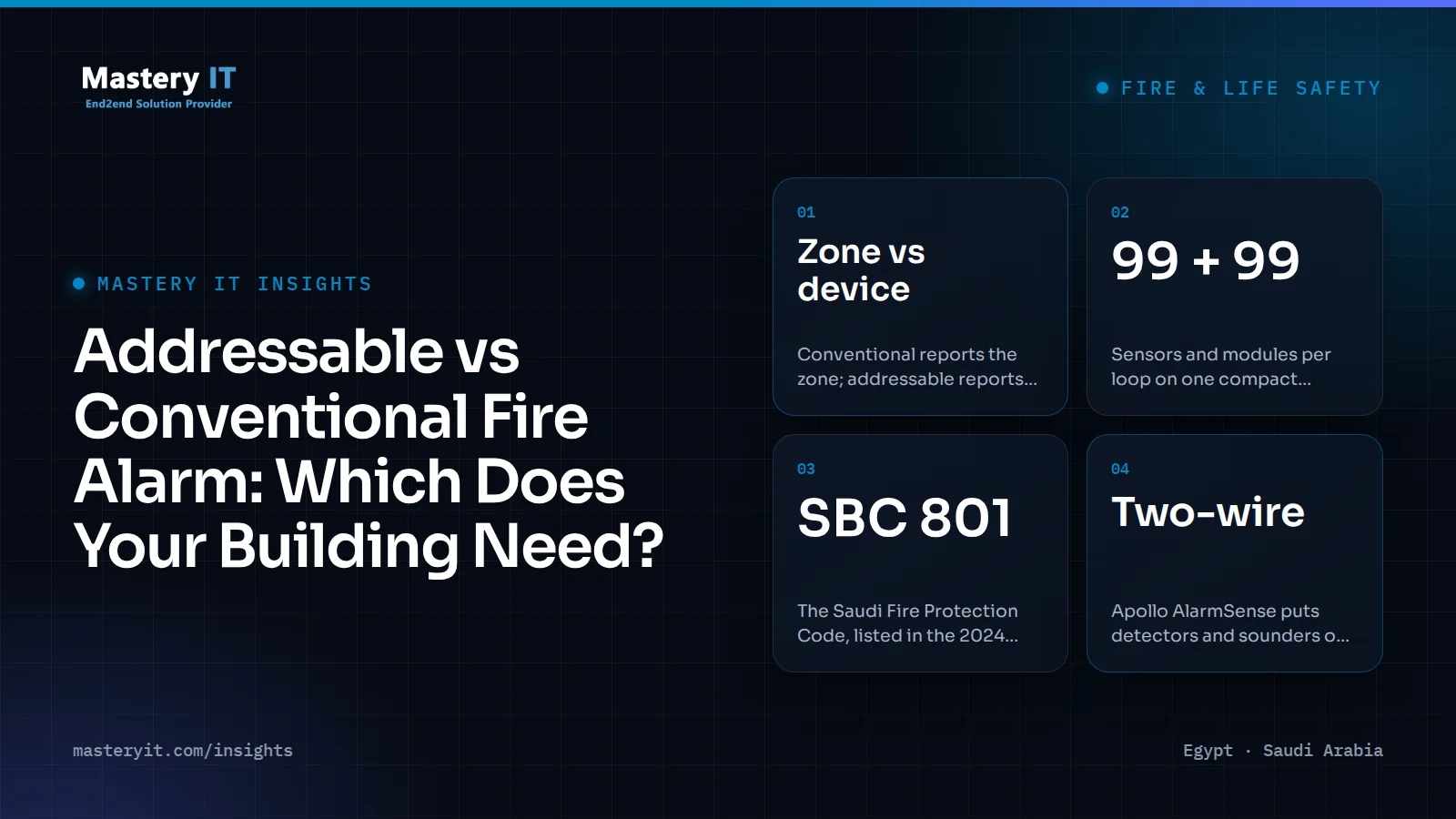
- Zone vs deviceConventional reports the zone; addressable reports the exact device (Protec, 2021)
- 99 + 99Sensors and modules per loop on one compact Notifier single-loop panel, now discontinued (Honeywell)
- SBC 801The Saudi Fire Protection Code, listed in the 2024 Saudi Building Code (sbc.gov.sa)
- Two-wireApollo AlarmSense puts detectors and sounders on one pair of wires, between conventional and addressable (Apollo)
Addressable vs conventional fire alarm: what are the key differences?
The table below compares the two system types point by point.
| Point | Conventional | Addressable (analogue addressable) |
|---|---|---|
| Wiring | Radial circuits, one per zone, back to the panel | Loop leaving and returning to the panel, shared by many devices |
| Alarm location | Zone only (for example, “Floor 3”) | Exact device and its programmed location text |
| Fault finding | Engineer walks the zone to find the fault | Panel names the faulty device |
| Capacity | Limited by the number of zone circuits on the panel | Many devices per loop, multiple loops per panel (model-specific) |
| Device and panel price | Lower | Higher |
| Cabling and labour | More cable runs as the building grows | Fewer runs on larger sites; longer programming and commissioning |
| Cause-and-effect logic | Basic, by zone | Programmable per device (doors, lifts, HVAC, suppression) |
| Typical fit | Small shops, small offices, small schools, villas | Hospitals, hotels, malls, towers, factories, campuses |
Which buildings usually use which system?
Conventional systems remain a sensible fit for small premises with a few zones, where anyone can walk a zone in a minute. Protec lists shops, small offices and small schools as typical conventional sites. A two-wire system such as Apollo’s AlarmSense, which Apollo calls “the happy medium between Conventional and Addressable”, targets similar buildings: small blocks of flats, guest houses, university halls, small shops and industrial units.
Addressable systems are the usual choice once a building has many rooms, several floors or people sleeping on site. Hospitals, hotels, shopping malls, residential towers, factories and warehouses benefit most, because staff need the exact location fast and the system often has to talk to other building systems. Typical integrations include access control door release, lift homing, smoke control, public address and voice evacuation, and fire fighting or FM-200 suppression. If you are planning several of these, it helps to design them together with your access control and BMS rather than one by one.
Planning a new building or upgrading an old zone panel? Our engineers can survey the site, compare a conventional and an addressable design for your floor plan, and give you one clear proposal.
What drives the cost of a fire alarm system?
We do not publish price ranges for fire alarm projects, because two buildings of the same size can need very different designs. These are the factors that move the number most:
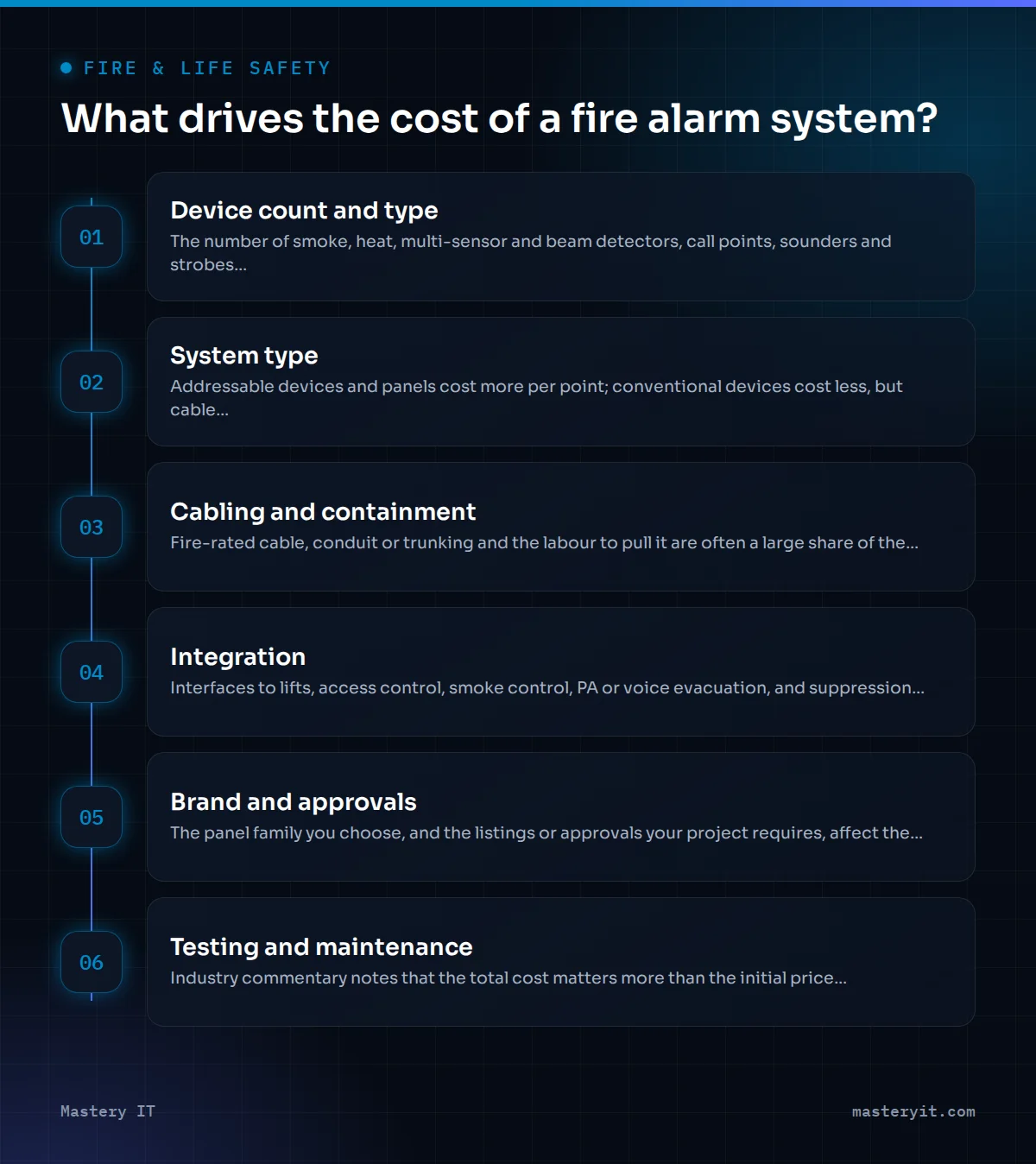
- Device count and type. The number of smoke, heat, multi-sensor and beam detectors, call points, sounders and strobes follows the floor plan, room use and the applicable code.
- System type. Addressable devices and panels cost more per point; conventional devices cost less, but cable runs grow with every extra zone.
- Cabling and containment. Fire-rated cable, conduit or trunking and the labour to pull it are often a large share of the total, especially in existing buildings.
- Integration. Interfaces to lifts, access control, smoke control, PA or voice evacuation, and suppression add modules, programming and testing.
- Brand and approvals. The panel family you choose, and the listings or approvals your project requires, affect the equipment shortlist.
- Testing and maintenance. Industry commentary notes that the total cost matters more than the initial price: conventional detectors can take more labour to test, while addressable panels can report device status and produce reports from their software.
What do Egypt and Saudi Arabia require?
Saudi Arabia. The Saudi Building Code National Center lists the Saudi Fire Protection Code (SBC 801) in the 2024 edition of the Saudi Building Code. The center describes it as the code that sets requirements for protection from fire and explosion hazards, minimum requirements for life safety and property protection, and a suitable level of safety for firefighters, including emergency and evacuation plans and fire protection systems. We have not quoted specific alarm clauses here: check the current requirements for your building with the authority (Civil Defense) and a licensed fire engineer.
Egypt. Egypt has a national fire code. The head of the Housing and Building National Research Center (HBRC) described it in September 2026 as the minimum safety requirements approved by the state. Whether your building needs a conventional or an addressable system, and how it must be designed and approved, depends on its use, size and the current edition of the code: check the current requirements with the authority and a licensed fire engineer.
The US reference standard many specifications cite is NFPA 72, National Fire Alarm and Signaling Code. The local authority decides what applies to your project.
Fire alarm systems are life-safety systems. This article explains the technology; it is not design or approval guidance. The system type, device layout and approvals for your building must be confirmed by a licensed fire engineer and by the competent authority (Civil Defense in Saudi Arabia, and the civil protection authority in Egypt) before you buy or install anything.
How do you choose between addressable and conventional?
Start with the building, not the panel. Ask four questions: How many zones would a conventional design need? How quickly must staff find the exact device at night? Will the system control doors, lifts, smoke fans or suppression? Will the building be extended or re-partitioned in the next few years? If the answers point to many zones, fast location, integration or growth, addressable is usually the better long-term choice.
Brand matters less than design and service, but stay with a family your installer can support for years. We deliver Notifier, Hochiki and Apollo systems, and choose the range per project, budget and site.
When you upgrade an old conventional system, you do not always have to rip everything out at once. Many addressable systems offer zone monitor modules, so existing conventional zones can be connected and migrated in stages. Confirm compatibility with the manufacturer’s datasheet first.
Frequently asked questions
What is the main difference between addressable and conventional fire alarms?
A conventional system tells you which zone is in alarm. An addressable system gives every device its own address on a loop, so the panel shows the exact detector or call point in alarm or fault.
Is an addressable fire alarm more expensive?
The devices and panel cost more per point. On larger buildings, fewer cable runs and faster fault finding can offset that, so compare the full installed cost and maintenance, not only the panel price.
Is a conventional fire alarm still acceptable?
Conventional systems are still made and installed, mainly in small and simple buildings. Whether one is acceptable for your building depends on the applicable code and the authority, so confirm it with a licensed fire engineer.
Does SBC 801 require an addressable system?
We have not seen a clause in the official sources we reviewed that we can quote on this. SBC 801 is the Saudi Fire Protection Code in the 2024 Saudi Building Code; check your building’s requirements with Civil Defense and a licensed fire engineer.
Can conventional detectors be connected to an addressable panel?
Often yes, through zone monitor modules on the addressable loop, which helps when upgrading in stages. Compatibility depends on the panel and detector models.
Which brands do you install?
Mastery IT delivers Notifier, Hochiki, Apollo and Simplex fire alarm systems in Egypt and Saudi Arabia, including design, installation, testing, commissioning and maintenance.
Bottom line
Conventional fire alarms are simple and cheaper per device, and they still suit small buildings. Addressable systems cost more per point but pinpoint every device, scale to large sites and integrate with other building systems. Pick the type that fits the building, then let a licensed fire engineer and the authority confirm the design.
Sources
- Addressable or Conventional Fire Alarm System? — Protec Fire and Security Group, 15 July 2021
- System types (Orbis, Series 65, XP95, Discovery, SOTERIA) — Apollo Fire Detectors, accessed 28 November 2026
- AlarmSense range — Apollo Fire Detectors, accessed 28 November 2026
- Compact addressable fire panel (NOTIFIER) — Honeywell, accessed 28 November 2026
- Conventional vs. Addressable Fire Systems — SecurityInfoWatch, 11 February 2015
- NFPA 72, National Fire Alarm and Signaling Code — NFPA, accessed 28 November 2026
- The Saudi Fire Protection Code (SBC 801) — Saudi Building Code National Center, 2024 code year
- Ahmed Medhat: the Egyptian fire code sets the minimum for safety — Al Mal News, 9 September 2026